Thursday, 8 September 2011

Ashni's Hosting Experience

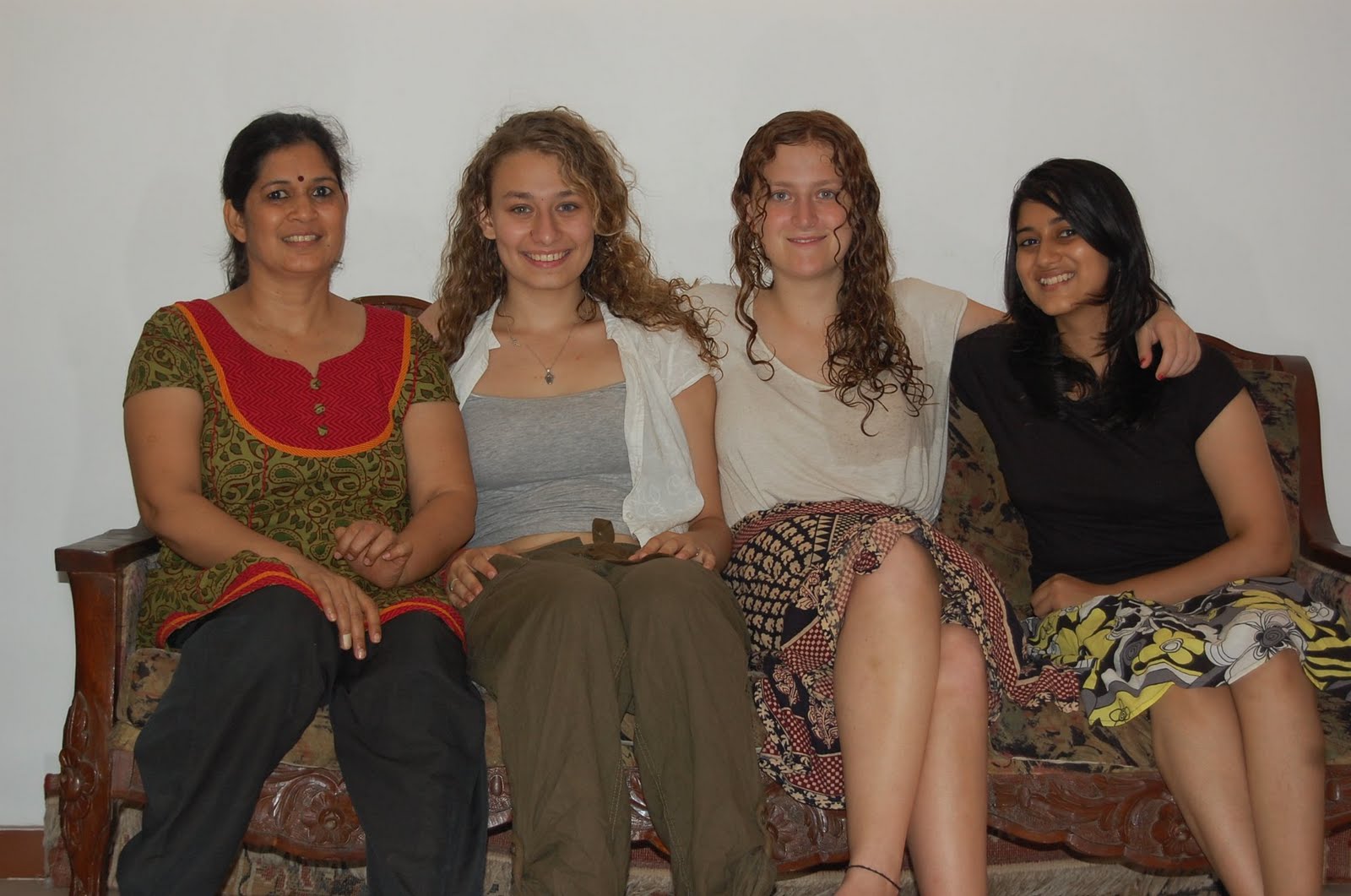
Mariah w/ Ashni's family & the huge but lovable Cujo & Buddy


Honestly, I did not know what to expect when I agreed to be a host sibling. I’m very picky when it comes to making friends, and I don’t get along with everyone. From the very beginning Mariah made it really easy for me to like her. I agreed to be a host sibling in the first place because I wanted the experience of living with someone from a completely different background but as the date of the intern’s arrival grew closer, my panic turned into fear; what if I don’t like her, what if we don’t get along? These were the questions filling my mind but the minute I met Mariah I knew I had nothing to worry about. I didn’t know what I was expecting but she certainly wasn’t it. I found her mature and independent and somehow- she fit perfectly into my life. Being from two different cultures we often ended up talking about the differences between the both. Our conversations often went late into the night and ranged from college to discrimination on the basis of gender and I loved every moment of it!

When we weren’t working with ITSA, we were just spending time with each other and getting to know each other as individuals. I wanted to make sure she got every possible Indian experience I could give her, including the delicious dish called Pani Puri which is personally my favourite. During the evenings, I normally hang out with my friends and she joined us making it even more fun. It was as if she had always been a part of my life. I had to leave for Ladakh, a family vacation planned, after ten days of the arrival of the interns and I regretted it because I couldn’t be there for the whole time they were in Ahmedabad. I also have to point out that all the other interns were also very interesting to talk to; I especially enjoyed Juliana’s company although I didn’t get to know all of them as well as Mariah. I wish I had more time to spend which each one of them so I could understand their views and theories about my country amongst other things.

I cannot thank ITSA enough for bringing such a wonderful human being into my life, it was by far one of my best summers and all the credit goes to Mariah Widman, seriously!

~Ashni Tripathi
National Institute of Fashion Technology
Ahmedabad & Hyderabad

Tuesday, 30 August 2011

Letter from host sibling, Deeksha...

Edited by: Ashni Tripathi, National Institute of Fashion Technology


Here is a letter one of the host siblings, Deeksha Joshi, wrote to ITSA India about her experience hosting after her interns Ana and Emma left for New York City upon the end of their stay in India:


"This summer was unlike any other for me. I had two brilliant individuals who traveled all the way from New York City to experience India and stay with me. I wasn’t just a host and they weren’t just the interns; we were friends. We did everything a group of friends would do, from going to the movies to gossiping - it was touching. Their love for Indian food and the late night talks we had made me truly happy. I could never say that I was bored with Emma and Ana around.


Being from different cultures altogether, what I enjoyed more than anything was talking about each other’s lives. They observed how I spent my day and we conversed about anything possible to talk about ranging from their lives, their likes, the places around, and how lives function in India.


Ana: what should I say about her? She dances spectacularly well and she loved my mom’s homemade chutney. I really didn’t feel uncomfortable for even a minute around her and I was really able to open up.


Emma: she’s beautiful, confident and sensitive. I found her New York “Big City” stories the most interesting out of all. Coming from such a different background I still found her so much like myself, especially since she loved spicy food! 


The experience was spectacular. Now that I have met Emma and Ana, it’s truly hard to picture this summer without them. Not only did I bond with them, but it seems like I know their families too, even though the only way I know them is through online means. To sum up the experience, only one word comes to mind: Mast (the Hindi word for fun and truly spectacular). 


I am already excited for next summer and all the adventures it will bring with a new set of international interns!"


Wednesday, 13 July 2011

Cows, Jews, and Tikkun Olam - Emma

Hey all.  I'm a bit nervous about posting this, and I apologize in advance for the superfluity of parenthetical statements. (tl;dr crowd: don't even bother.) 

I am Jewish.  This in and of itself isn’t particularly surprising.  A Jew in New York? Not such a novelty.   Judaism and I have undeniably had our issues.  We grapple several times a week, woman vs. religion,  (“Call me Yisrael*,” my epic would begin) and I have disavowed it more than once in a fit of general distaste.  However, never before have I felt so keenly connected to my own Jewishness than here, in Ahmedabad India, of all places.
*Yisrael, a Hebrew word meaning 'He who wrestles with god,' was the name given to Jacob, one of the fore-fathers of the Israelites/Jews, after he literally wrestled with God.
There are a few approachable reasons for this discrepancy, the least of which is the sudden deficit of an abundance of Jews in my immediate vicinity.
First: yesterday, ITSA went to a beautiful Swaminarayan Temple which, for those of you that don’t know, is a temple devoted to the celebration of Lord Swaminarayan, a religious figure from the 18th century who has been deified for his teachings in a sect of Hinduism.  In this massive and paradoxically opulent temple (I say paradoxical because Swaminarayan was an ascetic who allegedly both survived for eight years with only a gourd, a loincloth, a rosary, and a book of scripture and managed to climb a Himalayan mount without shoes) was a herculean idol, a huge and golden Swaminarayan.  

Well.

Perhaps it was my recent and prolonged proximity to holy cows (with whom Jews have had tense relations since that one incident at Sinai), or perhaps it was instinct, but my personal primordial Jew was awakened at this sight.  I suddenly felt an abrupt (if ultimately superficial) connection with Moses on the mount.  Where were my stone tablets of divine dictation?  Unlike Moses, the idol itself wasn't what pissed me off.  It was the deification of a man and the sight of people prostrating themselves before him. (But what of Buddhism? my inner judge cries.  To this I say the following; though Buddhism does venerate Gautama the Buddha, there is never any confusion as to his status as a mortal.) 
(Forgive me if I have offended you by commenting so harshly on Swaminarayan.  I don't know enough about it to cast judgement, truly.  What is written here is merely my reaction to the idol.)

Second: (there is a long preamble to this one) there are many monikers for the Jewish people, most of which are somewhat less than flattering. The one which I consider most pervasive is neither insulting nor complimentary: ‘the Chosen People.’  Though it smacks of a certain egotism, a certain quality of selective righteousness, I do not think it means ‘the people who have been chosen to go to heaven and live under God’s favor.’  Jews don’t have a heaven or a hell and they most certainly haven’t lived under the favor of a benevolent being.  
Personally, I think it is an epithet of burden and responsibility rather than of divine aristocracy.  

There is a Jewish concept, tikkun olam, which literally means “repairing the world.”  The idea is that the world is somehow broken or incomplete, but not irreparably so. An imperfect God (or an imperfect whatever divine absolute you choose to believe ) 'selected' the people who would become the Jews and gave them the responsibility of finding the remaining shards and placing them to right. It is a profoundly beautiful concept, one which simultaneously traps and frees. 

An aspect of tikkun olam is tzedakah, a word which means 'justice' and denotes a meting out of human justice, a concept similar to charity.  The idea is that one ragged shard that God callously left behind is poverty, and it is strongly suggested that we devote ten percent of our yearly income to tzedakah.  Essentially, if a person asks for money or help Jews are obligated not to turn away from them and to give whatever we can.  This has never been particularly important to me before, but confronted with the abject poverty and persistent begging common in India, I have found the fiat more and more pertinent and present in my mind.  I cannot guarantee that it will remain so back in the US, but it has been getting exceedingly difficult to turn beggar children away.

An old joke goes like this; one prostitute asked another if she could borrow the second's bed for the night.  When the second asked why, the first replied "I have a Jewish customer tonight.  Your bed is bigger than mine, and I need room for the Jew and for his guilt!"  Jokes aside, I am beginning I think to feel this guilt, this Jewish inclination towards tikkun olam and all its implications. Whether or not I want to be rid of it is something I have yet to decide, yet to fully comprehend. 

Eh. In the meantime, l'chaim! To life.

Monday, 11 July 2011

Who Should We Save?

Hey everyone (tl;dr people, go to the end).

    Three years ago or so, my group in sleep away camp had us all play a game.  It involved an impending and total nuclear holocaust and the ability to save only five people.  Each village member was gifted a single sentence descriptor of a person - mine was 'seventeen year old heroin addict' - and was told to choose which five (out of forty) were worth saving.

     A single description isn't a lot to go on, especially when you are acting as the arbiter of life and death.  There are things you must consider! For example; do you save the children, who might be dead weight, or the adult who, although useful, might not ensure the continuation of the human race and for that matter, is the perpetuation of the human race necessarily the ultimate goal at all?
     It is terrible and fascinating work to do, and in the previous workshop, we had the kids attempt to do the same.

Something funny was said

     Once they were divided into three groups, they were informed that the city was flooded, but there was a boat that could hold ten people, though fifteen were available to save: a smoker, a Muslim mother, a 150 Kg man, a rich bachelor, a beggar woman, a Sikh soldier, a female celebrity, a ten year old maid, an alcoholic, a Hindu man, a blind man, a man with AIDS, an engineer, an artist, and a mason.

     At first, the group I was in made snap judgements without a second thought. As an onlooker, I found it truly difficult not to react to some of their rationalizations with excessively acrobatic eyebrow gestures ("We shouldn't save the Hindu man!" they all agreed,  "he has nothing special to offer.")  When the decisions got too superficial for me to bear, I began asking questions.  Needless to say, my group got aggravated very quickly - first with me ("You're making things so confusing!"), then with each other ("You're only saving the Sikh soldier because your father is Sikh!"). 

    Then, they started to fight for the admission of certain individuals against others, giving critical reasons and backing them up.  It was sort of exhilarating, though when I laughed to myself the kids gave me looks of utmost incredulity.  Their views on certain people are unshakeable and solid, but as they fought I saw them pausing, sitting back, and blinking a bit at what they found themselves saying.

 Some of the kids explaining why their choices made it onto the boats (and lived)

    When it came to a group discussion though, the judgements came back a little and got more provocative.  Juliana, another intern, brought up the idea that instead of claiming that we are noble judges, suited ideally for choosing who might live and who might die, we ought to choose randomly.  No one person is ultimately more deserving of life than another. This went over their heads entirely.

     It is, of course, a long process.  You can't expect people who have been taught under an indoctrinatory education system their whole lives to rip free of inertia and bloom immediately into critical thinkers after only a few exercises.   Unrealistic, to be sure, but still, they are blooming at a remarkable speed. They have been so incredibly inhibited, mummified by the system, and it's such a pleasure to see them rip the system to shreds with a vicious pleasure in the workshops. I'm a bit giddy with excitement watching it happen, actually.

(tl;dr - we played a provocative game about choosing who gets to live in the workshop and the kids were judgmental but quickly more critical and then it was exciting)


~Emma, Intern 2011
Bard High School Early College