Thursday, 16 February 2012

Empowering Incredible Minds Who Can Work Towards A More Incredible India


Juliana (on the right) in action, talking to a group of  attentive students.


Traveling to India last summer as an Intern for ITSA has been one of the most significant and enriching experiences of my life. Besides encouraging critical thinking among young Indians, I had the opportunity to learn about a part of the world and a culture that was almost completely foreign to me.

Initially, it was evident that the kids participating in the workshops were students in a system that does not enable them to think creatively nor critically about themselves and their surroundings. Most of them described themselves as “disciplined”, but had a hard time identifying other idiosyncratic qualities in themselves. Encouraging them to write about their interests and curiosities was very interesting and fun, especially because they were very willing and excited about participating in the workshops everyday.

It is gratifying to know that education reform is not desired just by those who support global education reform and those who work with ITSA. It is also relevant to educators in the current Indian education system and most certainly by the kids themselves, who have come to realize that they are empowered by their own brilliant minds. 

During my time in India, I worked with Riana and Jwalin on ITSA’s workshop curriculum. The curriculum was mainly made of a series of writing exercises and group activities primarily centered on topics of identity. I revised the plan for each workshop before it happened. I made sure that the activities and writing prompts would be clear and appropriate for the kids. When discussing the plan for a workshop on spatial identity, or the different perceptions of a person, I brought up the idea of talking about stereotypes in Indian society with the kids. I thought it would be important to start promoting social awareness because social justice activism is another one of ITSA’s undertakings. As a team of interns and directors, we decided to do “the boat activity” with the kids: to expose them to a series of Indian stereotypes by asking them to save ten imaginative characters out of thirteen on a boat that was, fictitiously, about to drown. The characters could only be differentiated by single traits and social labels such as “beggar”, or “7-year-old maid who dropped out of school”. We wanted to make the kids think about themselves in relation to how others perceive them in their society, and how they view others based on societal stereotypes.

My host family was very loving and caring, especially Pavithra; my host sister. They were from Tamil Nadu, a state located on the tip of South India. Their food was very different than the North Indian food I had in restaurants. South Indian food is more spicy but equally delicious. My host father and I read the Indian news every morning over South Indian coffee, and showed each other family photos while sharing life anecdotes.

I enjoyed walking in the old city of Ahmedabad and observing people’s daily lives -women selling colorful vegetables that made an interesting contrast with the colors of their dresses, women cooking and washing their clothes while talking to their neighbors, and people meditating at various local temples. I remember smelling a Jasmin flower that a Hindu Pujari put in my hair after caressing one of his Gods with oil. 

Being able to appreciate and value Indian culture strengthened my sense of global diversity and inclusion. Besides, promoting critical thinking that will help young minds address social concerns in a country that is so rich in many other ways has encouraged me to continue to pursue youth empowerment. 

~ Juliana Gutierrez      
ITSA Intern-2011


Thursday, 19 January 2012

Call for Applications: ITSA India’s International Internship Program 2012


ITSA India’s International Internship Program 2012

Would you like to experience India’s beautiful and unique culture first hand while living with a host family this summer?

Would you like to like to intern in India?

Would you like to contribute to education reform and social change?


If the answer to any of these questions is a “Yes!”, intern with Independent Thought & Social Action in India (ITSA India), an education reform organization running Social Action Training Camps that promotes critical thinking and social entrepreneurship to students in the traditional, rote memorization based Indian education system.
After an extremely successful first summer with interns from New York City, ITSA India is excited to announce applications for the internship program for Summer 2012! Read about the interns’ experiences from last summer on the ITSA blog: www.itsatravellog.blogspot.com.

Please visit our Facebook page: www.facebook.com/ITSAInternational.

ITSA Intern responsibilities:

We are looking for passionate, motivated and energetic people to join our team this summer. We will be running experiential learning workshops teaching social organizing skills.  ITSA is entirely staffed by interns and volunteers and we will be expecting the interns to play an extremely central role in carrying out the workshops this summer. Our team will consist of college students from the US and India.

Interns will teach workshops and be involved in documentation work, curriculum development, education research, social media, publicity, blog writing, video creation, graphic design and website development & design. 

ITSA, the Institute of Writing and Thinking at Bard College, and Training for Change in Philadelphia will provide training and orientation to all interns prior to their work in India.

About the City: Ahmedabad, Gujarat, India

The city we will work in is Ahmedabad, the famous Mahatma Gandhi’s home during the Indian freedom struggle. We will have a trip to North India, which include places such as Delhi and Agra (home to the Taj Mahal). Experience the beautiful Indian culture, the delicious food, gorgeous monsoons, bustling markets, majestic forts, temples, palaces and all of the magic that makes India unique.

Housing:
Interns will be housed by warm and loving host families to gain an authentic immersion into Indian culture.

Program Dates: (Tentatively) Thursday, June 28th, 2011 – Thursday, August 9th, 2011 (6 weeks).

Program Cost:
The entire program will cost $1740. Transportation within India to all necessary ITSA and community service sites, home stay with an Indian family, three home-cooked meals a day and visits to sites within Ahmedabad & North India will all be covered.

Colleges often have grants/scholarships available to take on summer opportunities/summer internships abroad. The ITSA internship can also qualify for a research grant from your college if you indicate on your application that you are interested in doing research with us since we have research positions available as well. Check with your college’s summer opportunities office/career services.

The program costs also include a trip to the historic sites in North India including the Taj Mahal, Akbar’s Palace, Fatehpur Sikri, India Gate, Indian Parliament in Agra & Delhi.

[The cost does not include: transportation to Ahmedabad, personal spending money and visa application fees. Please note that similar organizations often charge three times our cost for similar length programs. The ITSA internship allows interns to truly make a difference in lives of students and to experience India from perspectives of Indian families while forming friendships with Indian peers.]

Application info:
The application requires filling out the online form and a recommendation letter from a professor or someone you have worked for. Here is a link to the application: http://bit.ly/InternInternApp. Recommendation letters and questions should be email to us at itsa@itsainternational.org.

Application Deadline: Wednesday, February 20th, 2011.  
Testimonials:
“Choosing to send in an application to become an intern was one of the best decisions I ever made, and I cannot sum up its worth and importance so neatly . . . going to India and being an intern for ITSA affects me still, every day, and I am in all respects continuously thankful for the opportunity.”            


  ~Emma King, Intern 2011, NYC (Emma’s Article in the newspaper, Bardvark: http://bit.ly/sAkpEq)

“It was a FANTASTIC experience! The program more than exceeded our expectations - and the amount of work you guys put into ‘educating’ the interns about India was truly amazing. It was a great opportunity to both experience a different country and culture, and take on a leadership role.”
            ~ Juliana Gutierrez, Intern 2011, NYC
We will be happy to put you in touch with our past interns and their families if you wish to contact them for more information.
Sample Day:

Day 3:
Meeting the Mahatma
Morning
ITSA meeting

The entire team will spend time reflecting, strategizing and preparing for that week’s ITSA workshops. Interns will also have this time to work on their individual or collaborative ITSA related projects.
Afternoon
Screening of the Bollywood film Lage Raho Munnabhai:

        Through his interactions with the image of Gandhi, Munna Bhai, an amiable, good hearted, underworld don, begins to practice what he calls ‘Gandhigiri’ , the modern version of the Gandhian ideals of non violence and truth helping ordinary people solve their problems.
        In this light hearted comedy about India’s father of the nation, Munna Bhai changes the way people think about non-violent change in the modern world applying Gandhi to the 21stcentury. A critically acclaimed film, it is the first Hindi film to be screened at the UN auditorium.
Evening
Tour of the Sabarmati Ashram: Mahatma Gandhi’s home

        The Sabarmati Ashram (also known as Harijan Ashram) was home to Mohandas Gandhi from 1917 until 1930 and served as one of the main centers of the Indian freedom struggle. Originally called the Satyagraha Ashram, reflecting the movement toward passive resistance launched by the Mahatma, the Ashram became home to the ideology that set India free. Sabarmati Ashram named for the river on which it sits, was created with a dual mission: to serve as an institution that would carry on a search for truth and a platform to bring together a group of workers committed to non-violence who would help secure freedom for India.
        Today, the Ashram serves as a source of inspiration and guidance, and stands as a monument to Gandhi’s life mission and a testimony to others who have fought a similar struggle.


Intern Max Baird’s Blog Entry about our visit to the Gandhi Ashram in Summer 2011


Before visiting Gandhi’s Ashram, I had a sense of who Gandhi was and what he stood for, but I didn’t really understand how large a role he had in the public conscience. Dr. Martin Luther King Jr., who was inspired by Gandhi, left a similar legacy to us, but not nearly to the extent Gandhi has for India. His Ashram was an incredibly peaceful place. An ashram is spiritual community, and we had gone to the one Gandhi lived in for thirteen years. Before entering Gandhi’s house, the ITSA team sat outside while a woman showed us how to spin thread. It was a calming activity, and the Ashram itself was quiet, something you begin to value more when cars begin honking at five A.M in New York City. 
It's not only Gandhi’s political achievements that I find so remarkable. If Gandhi had lived the way he did and spent his entire life in a small village, he would be no less extraordinary. I’ve seen a quote of his, “My life is my message,” in multiple places around Ahmedabad, which, to me, sums up what I'm trying to say. He was able to live a meaningful life, and his achievements flowed out of that goal. So often the outside world appears to be incompatible with whatever peace I can find internally. How can someone be truly virtuous and at the same time stand to live in a world with so much suffering? Gandhi’s Ashram was a very comforting place for me because it was the home of a man who was able to apply his ideals to his life so thoroughly.
            (Read more entries at: www.itsatravellog.blogspot.com.)

Thursday, 24 November 2011

ITSA: Inspiring Student Confidence

Rajvi Patel, a student who was part of the ITSA workshops recently wrote us the most touching letter. This is really encouraging to see, and these sentiments from our students are what keeps us going:


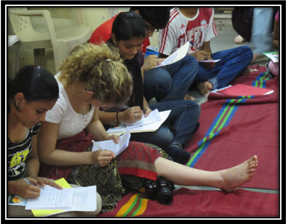
Rajvi, hard at work on her identity chart, reflecting on changes in her identity.


"The entire experience of ITSA was mind blowing. The workshops were great; there were so many activities involved. We played interactive games, had discussions and the program helped increase our awareness about the socio-economic conditions of our country. I now know that we are the future leaders of our country and this workshop helped me realize it.

The ITSA workshops are completely different from how we function at school.School is based on being disciplined, which makes it difficult to express ourselves the way we truly want to. We sit in front of a teacher lecturing while we try our best to stay awake in class,  Our dialogue in class, revolves around questions we have about our textbook material. ITSA made sure that we were truly using our mind and our own perspective to communicate. It was a platform to present ourselves with no restrictions or guidelines about how we SHOULD think. Not once during the workshops did I feel sad or left out; the atmosphere was cheerful and merry. It was Knowledge with fun and helped me truly grow!


In the ITSA workshops it didn't feel there was the teacher, as the disciplinarian, and the restof us were the students and receivers of information. We were all a big group of friends; that’s how it felt. This made for a healthy atmosphere and an open environment. The whole workshop taught me more than I had imagined to begin with; improving me as a thinker, being able to converse easily, a smile all the time, and so much more. My life has changed completely because of ITSA. I used to be a little shy and I couldn’t converse as easily before, but now, I have found my voice and more confident. It is because of ITSA that I believe in myself more than ever before and because of that self confidence, people believe in me.

My favourite activities were the Boat activity because it involved a lot of discussion as we determined who we saved.  We were all expressing ourselves freely without thinking twice and without censoring ourselves. The video activity involving the discussion of a movie clip was also interesting as we discussed the different characters in detail. The activities I liked were all based on freely communicating our thoughts and perspectives without any boundaries to restrict us. 

I truly believe in the message of critical thinking that ITSA brings to us and I will try to spread its message and values wherever I go. I believe ITSA is truly awesome and deserves to be recognized. It helped me so much and I honestly think it can do wonders for so many others. Thank you ITSA!"


Written by: Rajvi Patel, 9th Grade


Edited by: Ashni Tripathi

Tuesday, 22 November 2011

An Article on ITSA in the Swarthmore Newspaper!


Student project aims at Indian 

educational reform

In print | Published October 20, 2011 — Updated November 21, 2011 14:06


In a sweltering Indian classroom, as a student raises her hand with a question to understand the concept of photosynthesis, she is silenced by her teacher with instructions to memorize the definition on the blackboard. This authoritarian system has silenced questions and stamped out curiosity over the years as students follow the traditional system of rote memorization.
Riana Shah ’14 and Jwalin Patel may finally be able to break the silence. The duo co-founded the organization Independent Thought and Social Action (ITSA) about two years ago during their senior year of high school in an effort to reform and modernize the Indian educational system. As an internationally recognized educational reform organization, ITSA strives to provide Indian students with an outlet to discover themselves as thinkers and learners through a series of critical thinking, writing and discussion summer workshops.
Patel, now a student at the University College London, but previously a student of the Indian system who switched to an international educational high school, reflected, “As I went through the Cambridge system of education I realized there was a big divide between the two systems. The Indian system of education was not much of an education. It was just lots of information without a focus on developing critical or creative thinking skills.” Educated in India until the ninth grade, Shah’s frustration with pure academic regurgitation and minimal discussion reached its zenith as she realized the large disparity between her education at Bard High School Early College in New York and the traditional Indian system she was once a part of.
At Bard High School Early College, Shah was convinced that teachers need not be authoritarians who have the last word and that many answers come in shades of gray. “The realization that my solutions have just as much power to make an impact empowered me, so why shouldn’t students in our hometown of Ahmedabad have the opportunity to feel the same way?” she said. The motive behind ITSA’s construction was to reform a traditional school system based on rote memorization and passive learning to a dynamic one “geared toward producing thinkers and not solely technicians,” according to Patel.
Pooling their educational experiences together, they incorporated the methodology developed by the Institute for Writing & Thinking at Bard College into the ITSA curriculum to foster the thinking skills needed by the next generation of world leaders.
Initially after conception, ITSA implemented its curriculum in two schools. However, this past summer, ITSA has expanded its affiliation to over twelve schools in two different cities in the Indian state of Gujarat, Ahmedabad and Rajkot, with the help of a formal internship program, the Swarthmore Foundation Grant and a few Swatties who were dedicated to their vision.
Piecing together narratives from ITSA’s student-run blog, Emma King,ITSA intern and student at Bard, Shah’s alma mater, writes about ITSA’s identity workshops detailing how ITSA delves deep into the students’ minds to extricate all that they wish they could share. King noted that most of the kids initially described themselves as “obedient,” “polite” or, most frequently, “disciplined.” After the open-class discussions giving these students a nudge to identify qualities in themselves that weren’t held to societal standards, the children used words such as “creative,” “independent” and a “learner for learning’s sake” to describe the fabric of their being.
Each year ITSA workshops have a different theme based on various forms of social responsibility. Moving outside the confines of the classroom, they have begun a mentoring program to put the students’ passions into action.
ITSA team member, Meghna, who is studying engineering in college upon witnessing ITSA’s discussion forums, said that, “had something like ITSAbeen in my life when I was in high school, I might have chosen differently.”
Patel and Shah have brought awareness of the global education systems to campus, and are in the process of applying for the Lang Opportunity Scholarship worth $10,000 to fund these efforts. The exponential growth and impact that ITSA has had foreshadows what collaborators envision to be “the possibility for not only regional change, but also a national remodeling.”
ITSA has freed students from traditional educational constraints, so much so that a student exclaimed, “It’s like we actually have freedom of speech here!”

Direct Link: http://www.swarthmorephoenix.com/2011/10/20/living/student-project-aims-at-indian-educational-reform