Sunday, 10 July 2011

Picture Post

Every now and then, we are going to post a picture sans a blog post. This is the first of these.
A boy and his motorcycle - Emma

The Monsoons - Emma

Hey all. I’m going to wax briefly poetic in this entry and I beg forgiveness in advance.
The monsoons started a few days ago, and I don’t have any relevant pictures.  None of the ones I took were good enough.  The rains had been teetering on the edge of release for my entire stay in Ahmedabad thus far, but hadn’t come.  The odd dryness lent, I realize in retrospect, an aura of anxiety and tightened lips to the entire city.  Without the rains, the year cannot progress.  Without the rains, the city could not move forward. It is thus with excitement and joy that they were met when they finally began. 
The rain wasn’t the torrential buckets of water I was told to expect but it flooded the streets in minutes anyway, forcing walkers to wade through impromptu lakes and turning cars into ad hoc boats.  The clouds rolled overhead in great cataracts of grey.  It was awesome in the biblical sense. 
this is the best picture I got.  It is still inadequate

       The thing, however, that had the greatest impact on me was the juxtaposition of the water against the the city.  Ahmedabad has sprung into a truly urban environment only in the past thirty years or so.  A city of advertisements, concrete, and cars, it is modern and intensely so - even if it appears to Western eyes to be a bit delayed in that modernity. Seeing the rain (this primeval torrent of water, this persistent pattern which provided the constrictions by which India, both modern and ancient, was formed) stream into the city was a sort of stark reminder that even in the midst of the 21st century, the rains are the rains are the rains are the rains (as Gertrude Stein might posit).  The rains are the past and the present and the gateway to the future.

In the meantime, however, they are the harbinger of bugs.

Friday, 8 July 2011

Max: Gandhi Ashram

Hey all;
Before visiting Gandhi’s Ashram, I had a sense of who Gandhi was and what he stood for, but I didn’t really understand how large a role he had in the public conscience. Martin Luther King Jr., who was inspired by Gandhi, left a similar legacy to us, but not nearly to the extent Gandhi has for India. His Ashram was an incredibly peaceful place. An ashram is spiritual community, and we had gone to the one Gandhi had lived in for thirteen years. Before entering Gandhi’s house, the ITSA team sat outside while a woman showed us how to spin thread. It was a calming activity, and the Ashram itself was quiet, something you begin to value more when cars begin honking at five a.m.
It's not only Gandhi’s political achievements that I find so remarkable. If Gandhi had lived the way he did and spent his entire life in a small village, he would be no less extraordinary. I’ve seen a quote of his, “My life is my message,” in multiple places around Ahmedabad, which, to me, sums up what I'm trying to say. He was able to live a meaningful life, and his achievements flowed out of that. So often the outside world appears to be incompatible with whatever peace I can find internally. How can someone be truly virtuous and at the same time stand to live in a world with so much suffering? For instance, state-sponsored torture is something that seems so empty of meaning that any religious experiences I’ve had in my life seem hollow. Gandhi’s Ashram was a very comforting place for me because it was the home of a man who was able to apply his ideals to hsi life so thoroughly.
A room in Gandhi's house with a spinning wheel and chair.

Thursday, 7 July 2011

The Old City - Emma

Hi, everyone.  A brief disclaimer - please click the links for more pics or go to my flickr account here or here.  It's worth it, I promise.

There is an assumption (at least among cynical New Yorkers) that when you travel, you never really see the full width and breadth of the place you are visiting.  To a certain extent, this is true.  Tourists tend to stay near tourist attractions, if only because they are safe and often the only place they know to go. But - and this is a large interjection - the full scope is there. All that's required is searching a little further than we ordinarily would.  
Here. This is what you search further to. 
(this picture doesn't even begin to capture the insanity, the color, and the beauty of the old city)

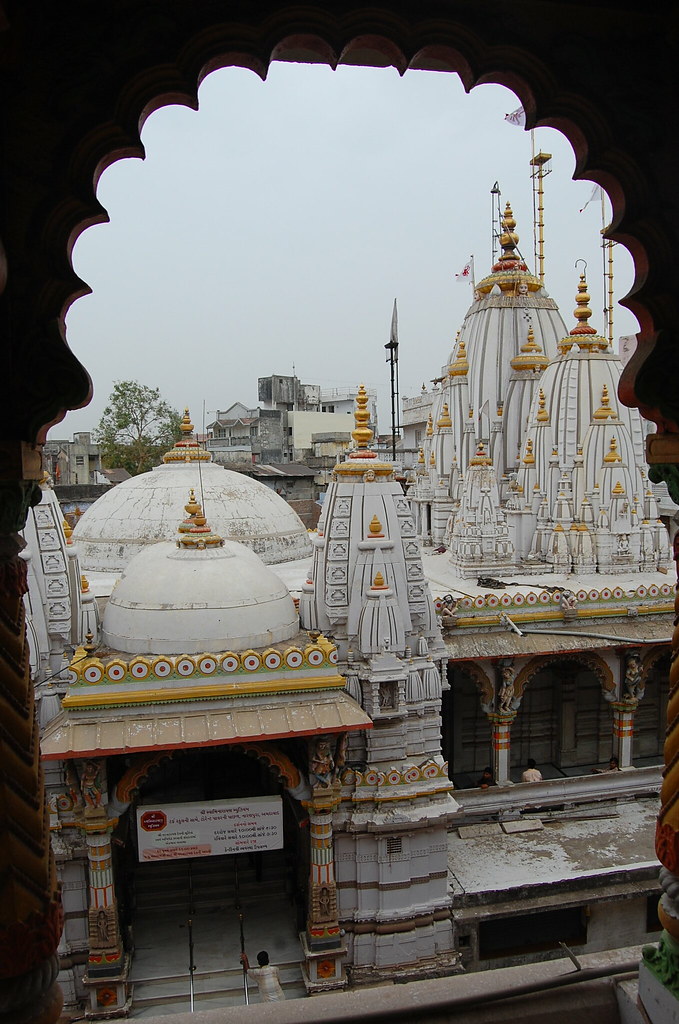
Today, we went on a historical walk in a part of Ahmedabad called the Old City, which is saturated with a combination of reminiscent atmosphere that seems almost fictive and the stampede of modernity.  It is all winding, narrow streets, stone houses, an eclectic mix of architecture (imagine an ambivalent artist, switching from European styles to Indian to Middle Eastern and back again, irrespective of time period), motorcycles and motorized rickshaws and people thrust together by the limitations of space.  

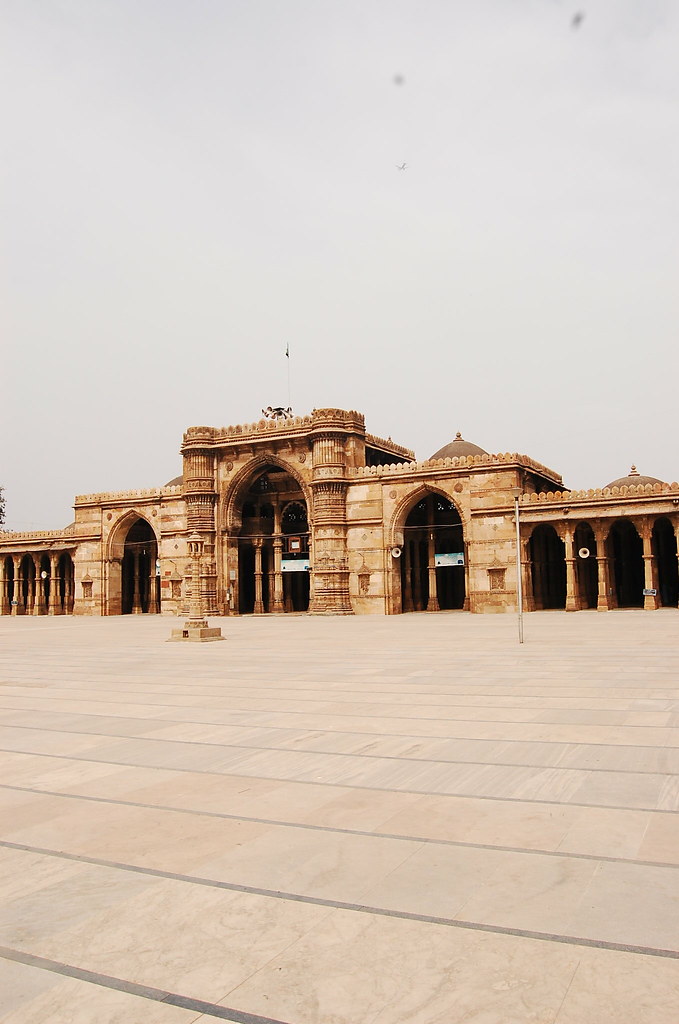
The walk began at the Swaminarayan Temple, snakes through the domestic pols (neighborhoods) of the city and ended at the spectacular and entirely unique Jama Masjid Mosque.  This is one of those times when pictures speak louder than words, so let me yell.
You can't tell from this distance, but the woman in the window is beaming. 


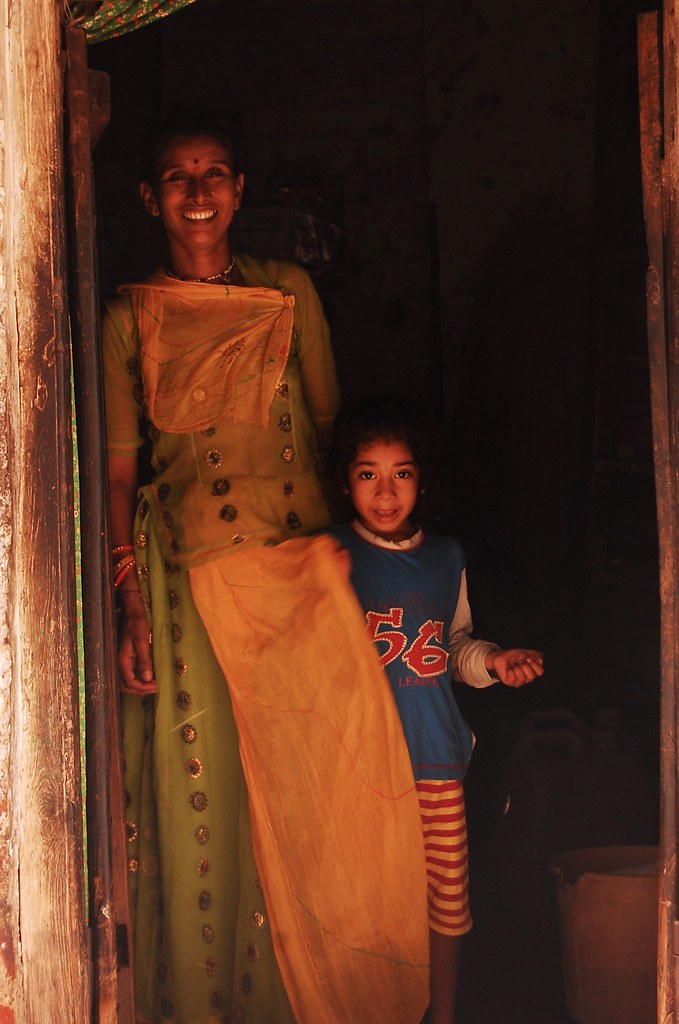
Throughout our stay in Ahmedabad, we have received stares.  This in and of itself is unsurprising; we look different and some of us (myself included) have hair color that simply doesn't occur naturally in India. However, we don't usually get smiles and frequent petitions for photographs.  The people here are friendly, incredibly interesting to look at, willing to be photographed,  though they are poor (I'm not sure why this is a concessive clause, but I cannot deny that it is.)   


 This woman asked me to take pictures of this child and of her.  It is a way, I think, of raising awareness.

They live. They yell and gesture and love and cook and clean and honk and almost run us over with rickshaws and sometimes, they just stare.

Like this gentleman.

I can’t begin to describe how wonderful it was to smile at people (I couldn’t stop) and to receive wide and often surprised grins back.  I cannot fully communicate the feeling one gets when walking through narrow streets, knowing that you are there.  I can’t explain why going into a mosque can translate you from one universe to another, one where the heat rising from the white stone of the courtyard is - as another intern said - raw and the odd contrast of white on white is somehow more profound. I don't know how to explicate the excitement that comes with the chaos of narrow streets and the smells of different cultures. How can anyone perfectly put into words the snuffling curio of claustrophobia and the sheer, clean relief of the open sky? It is something a person simply has to experience for themselves.